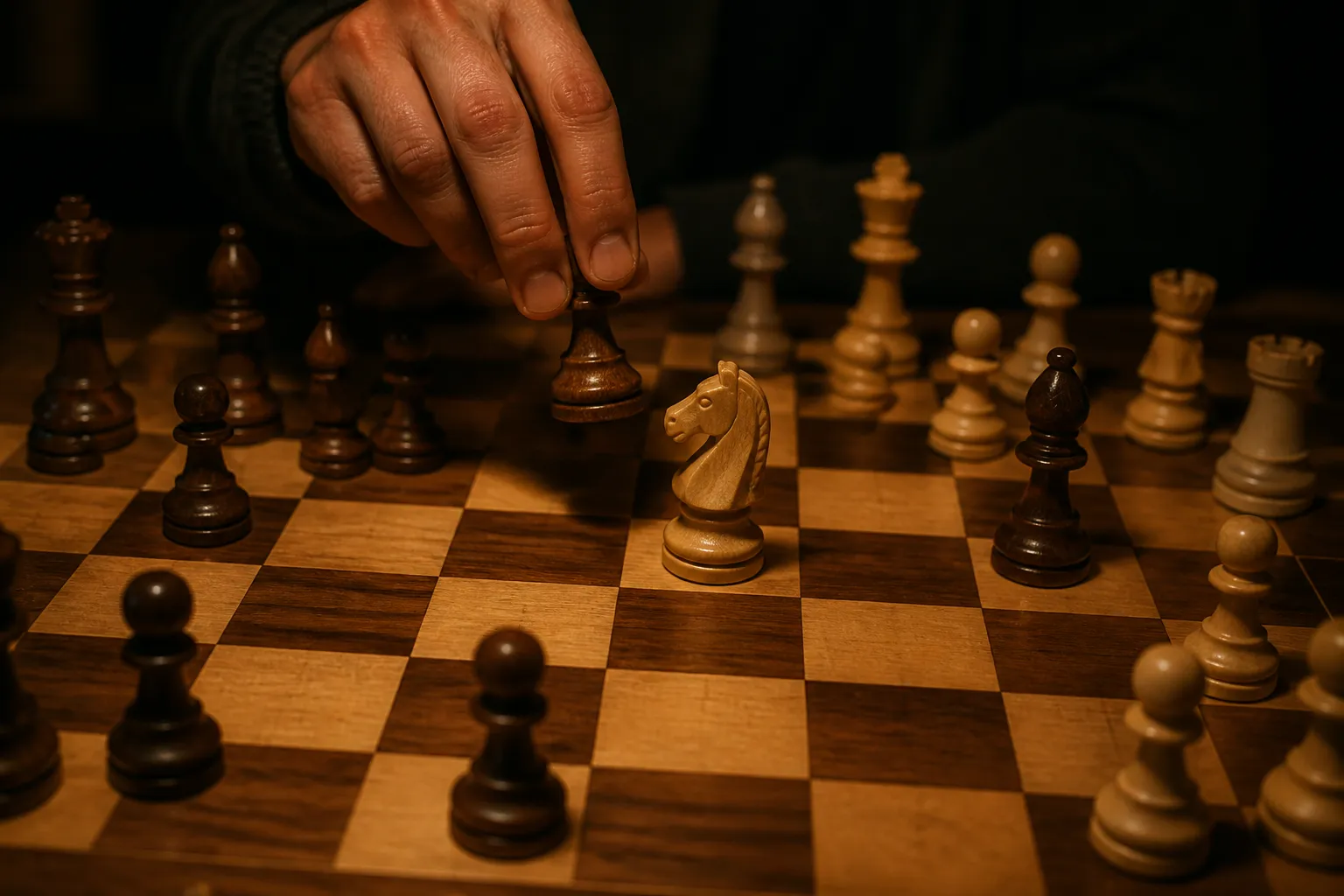

A defender can look perfectly sound while doing the work of two pieces. The position gives no warning label. A queen covers a knight and a rook; a rook guards a queen and the back rank. Both duties are being met, so the arrangement appears stable. Then a forcing move asks the defender to choose.
Act I: Notice the workload
Overloading is the name for this small failure of staffing. One piece has two or more important defensive jobs, but it can answer only one threat with its next move. If an attacker makes one job urgent, the other may be left undone. The tactic can be easy to miss because the defender is not pinned or visibly trapped. It is simply occupied.
At the board, players often ask, “Is that piece defended?” The more useful question is, “What is doing the defending, and how many jobs does it have?” A protected target can still be vulnerable when its protector is stretched. That distinction catches a common blind spot: checking the safety of the piece under attack without inspecting the piece responsible for its safety.
Overloading belongs to the same family of ideas as deflection and decoy. The names point toward a shared action: make a piece leave, or stop performing, a useful duty. For this drill, keep the label simple. Find the defender with several responsibilities, then make one of them impossible to ignore.

Act II: Take the defensive census
Before calculating a combination, make a quick inventory of the enemy’s important defenders. For each one, write down the critical squares, pieces, or mating threats it protects. This need not become a ledger worthy of a tax office. A few notes are enough to turn a vague impression into a map.
Sort the results by workload. A piece with no critical job is unlikely to be the key. A piece with one job may be vulnerable to deflection, though pulling it away can cost material or time. A piece with two or more important jobs deserves first attention. Its apparent stability may depend on being allowed to do all of them at once.
“Important” matters here. A bishop guarding an empty square and a rook guarding mate are not equal entries. Ask which duty changes the position if it is abandoned. The most promising target is often the defender connecting two threats that would otherwise be unrelated.
- Name the defender.
- List its critical duties.
- Mark which duty can be attacked with check, capture, or a direct threat.
- Identify what becomes loose if the defender responds.
This is the working sheet for the exercise. It also prevents a familiar waste of effort: calculating attractive moves before knowing what they are meant to exploit.
Make the defender choose
The drill has three moves of thought, even when the solution takes fewer moves on the board. First, locate a piece responsible for two or more critical duties. Second, attack one duty with a forcing move. Third, collect the duty the defender can no longer maintain.
Forcing moves matter because they deny the opponent a quiet moment to rearrange the defence. A check must be answered. A threatened capture may demand an immediate response. A direct threat can make the defender spend its move on the danger in front of it. A quiet move gives the other side time to patch the second weakness, which is considerate but not usually helpful.
The winning move may look plain. It can be a capture or a one-move threat rather than a long sequence of sacrifices. The difficult work happened earlier, when you noticed that the same defender was responsible for two outcomes. After the forcing move, pause and ask what that piece can no longer guard.
Also check the cost of refusing the bait. If the defender does not respond as expected, does the attacker simply win material? Or does the threatened danger become decisive? A sound tactic should account for the opponent’s practical choices, not only the line that makes the idea look neat.
Read the two positions by hand
In the first example, Black’s king is on g8, the queen is on d7, a knight is on c6, and a rook is on e8. The black queen defends both the knight and the rook. White plays 1.Qxc6!, taking the knight. If Black accepts with 1...Qxc6, White has 2.Rxe8+. The queen must meet the check with 2...Qxe8, and White finishes 3.Rxe8#. The white rook’s final capture delivers back-rank mate. If Black declines the first capture, White has simply taken the knight. The queen could not preserve both duties once the sequence began.
Notice the order of the reasoning. White does not begin by admiring the queen on d7. White sees two defended targets, asks whether one can be attacked with tempo, then checks what happens when the queen answers. The queen’s recapture on c6 is the move that leaves the rook on e8 exposed to the forcing sequence.
A second example uses a black rook on d8, which protects both the queen and the back rank. White plays 1.Re8+. If Black answers 1...Rxe8, the rook has moved from its back-rank duty, and White plays 2.Qxd5, taking the queen. This is sometimes presented as a ladder trick: the rook is pulled away and the queen loses its support. Write the rook’s two duties beside it before calculating. The move becomes much easier to understand.
Questions for the next position
Use the same short set of questions during a puzzle or a game. What does each enemy piece defend? Which of those duties are critical? Is one piece responsible for two targets? Can a check, capture, or direct threat force it to answer one duty? If it does, what falls? If it does not, what have you won?
Be cautious when a defender looks safe because every target it guards is protected by something else. That arrangement may be sound, but it may also be a chain of duties passing through one overworked piece. Test the chain with a forcing move. The point is not to assume that every busy defender collapses. It is to find out whether it can meet both demands.
For practice, take a position, choose one side, and spend a minute listing its critical defenders before searching for checks and captures. Then calculate the opponent’s best reply, including the option to decline a recapture. This keeps the exercise close to play: first inspect the responsibilities, then make the defender answer, then count what remains. Sometimes the piece holds. Sometimes one move asks it to be in two places at once.