
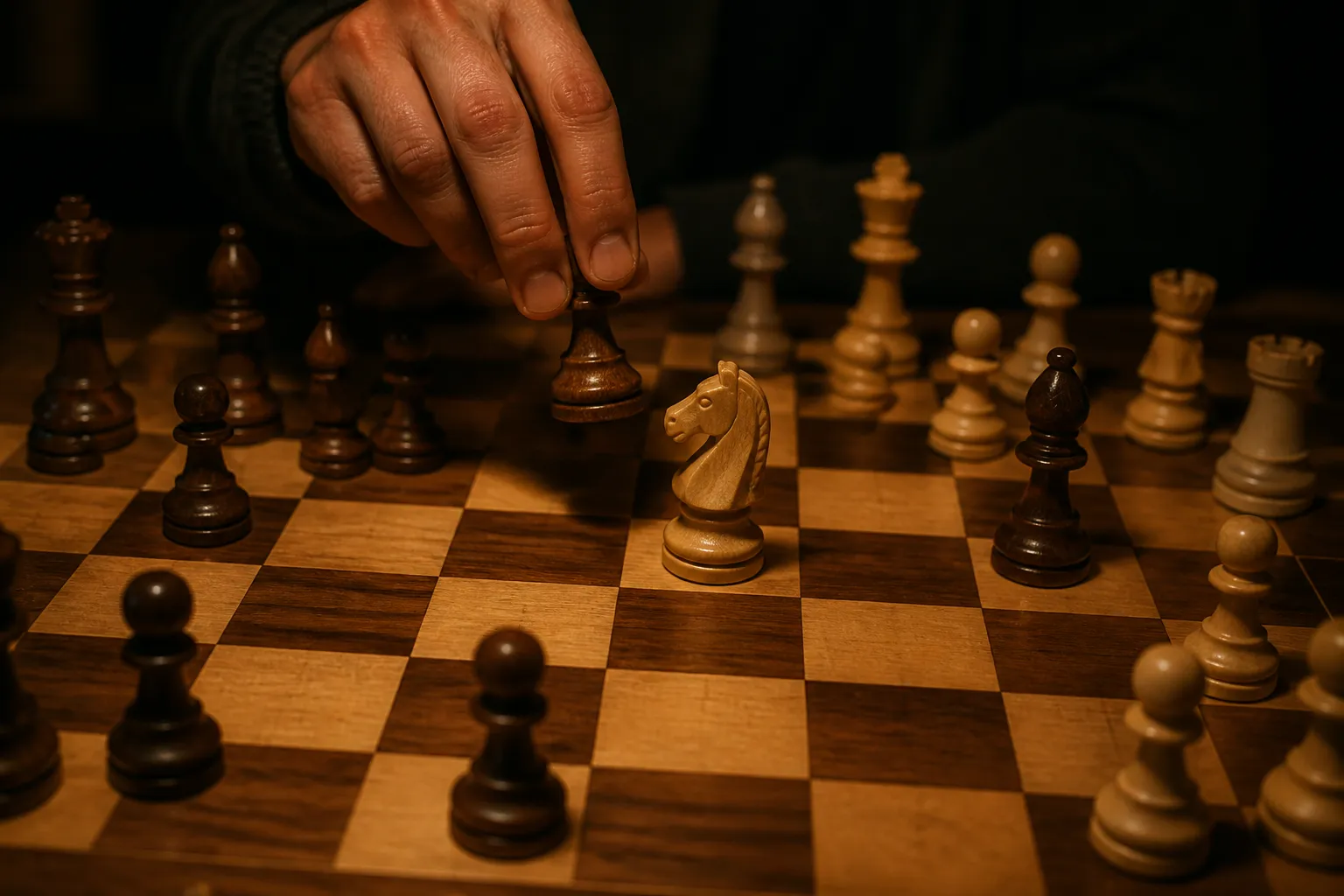
Most chess blunders do not begin with a wild move. They begin with a tidy one. A rook has just been captured, a pawn is ready to recapture, and the hand starts moving before the mind has finished looking. The zwischenzug interrupts that little ceremony. It asks for one more scan of the position, especially for a check, a capture, or an attack that cannot wait.
Before you recapture, ask one plain question: what is the most urgent move on the board?
What the Quiet Square Asks of the Player
Zwischenzug is German for “in-between move.” The Italian synonym is intermezzo, which gives the idea a faintly theatrical air. In practice, it is less opera and more interruption at the kitchen table. A player appears ready to make the obvious move, usually a recapture, but inserts a forcing move before doing so. The original exchange can then be completed, often with an extra pawn, a safer king, or a better piece placement as the reward.
Consider the basic shape. Black has just taken something on d6. White seems obliged to recapture on d6. Before playing that move, White checks for a forcing option. If White can play a check that Black must answer, and then still recapture on d6, the order matters. The board has not changed by magic. It has changed because one side made Black respond before Black could settle the exchange.
The term itself is younger than the tactic. Fred Reinfeld and Irving Chernev used it in their 1933 book Chess Strategy and Tactics, while the underlying idea appears in much older games. The label arrived after the habit. Chess has always rewarded the player who notices that the obvious next move is not necessarily the next move.
Why the Interruption Works
A zwischenzug depends on a commitment. The opponent has calculated, or at least assumed, a particular sequence: “I take, you recapture.” Your intermediate move breaks that expectation with a demand. A check is the cleanest demand because the opponent cannot politely ignore it. Captures and direct attacks can work too, but they must create a real obligation.
One useful test is severe and simple. Can the opponent ignore your proposed in-between move and carry on with the exchange? If the answer is yes, the move is probably just a move. It may still be good, but it is not doing the special work of a zwischenzug. The interruption needs to change the order of attention.
A familiar illustrative line begins with Bxf7+. The bishop captures on f7 with check, forcing Kxf7. Only then does White play exd6, recovering on d6 with a tempo already extracted. The exact position matters, of course. The point is the sequence: check first, recapture second. If the king could ignore the bishop, the pattern would collapse. Since it cannot, the check purchases a move.
This is why the tactic often feels unfair to the defender. The original recapture remains available. Nothing has been sacrificed merely to make a decorative detour. The opponent has been made to answer an urgent question before returning to the expected exchange. The practical explanation of the tactic puts the emphasis where it belongs, on whether the opponent can safely disregard the intermediate move.
Puzzles That Retrain the First Glance
Puzzle practice is well suited to this habit because a puzzle freezes the moment when routine takes over. The position often contains an exchange that seems to announce its own continuation. Your task is to refuse the announcement for a few seconds. Look at checks first. Then captures. Then attacks on a queen, rook, or exposed king. Only after that should you make the expected recapture.
Try reading a puzzle in two layers. First, describe the story the board appears to tell: “My bishop was taken, so I should recapture.” Second, suspend the story and list forcing moves in algebraic notation. Is there a check on f7? Can a rook capture a loose piece with check? Can a knight attack the queen from f4? The celebrated Lasker and Tarrasch example is often cited for precisely this kind of interruption, with Nf4 attacking the queen before the expected continuation.
Do not rush to collect famous names as souvenirs. Lichtenhein and Morphy, Rosenthal and De Vere, Tartakower and Capablanca, and Lasker and Tarrasch are useful historical signposts, but the training value sits in the move order. Write down the position. Name the expected move. Find the forcing move. State the opponent’s reply. Then check whether the original capture remains possible.
An endgame can sharpen the same reflex without the clutter of a middlegame attack. Suppose a rook trade appears to lead to a pawn recapture. Before taking back, check every available pawn capture with check, every rook check from the side, and every move that attacks the opposing king. In a sparse position, one tempo is visible enough to feel almost rude. That is useful. The board gives you fewer places to hide from your own assumptions.
A Four-Question Check Before You Play
The following checklist is deliberately modest. It is not a complete tactical system, and the available sources do not provide a graded curriculum or study showing that zwischenzug training directly improves tournament results. It is a working pause for puzzle positions and for the occasional live game in which the board has gone quiet.
- What move do I expect to play? Say it precisely, such as “B takes d6” or “Rook takes e5.” Vagueness makes it harder to notice that you have already decided.
- What checks are available? Check every piece, including the one that appears to be needed for the recapture. A check from f7, d8, or the side of the board can be easy to miss when the eye is fixed on the captured piece.
- What captures or attacks force an answer? An attack on the queen may be enough, as in the Nf4 motif, but only if the queen cannot ignore it and improve the position elsewhere.
- After the reply, can I still complete the original idea? Confirm the recapture, and confirm that your intermediate piece has not walked into a counterattack. Surprise is not a substitute for piece safety.
The last question is the one that saves the most amateur combinations. A player sees the check, enjoys the check, and forgets what happens after the king moves. The quiet square is often the square where the original capture still waits. If that square is no longer available, the interruption may have been a scenic route to losing material.
Where the Habit Has Limits
Not every delayed recapture hides a tactic. Sometimes the direct move is best, and a search for drama only spends time. A forcing move must be more than interesting. It must improve the position or prevent a useful continuation for the opponent. If the king answers your check, captures your checking piece, and leaves you unable to recover, the board has delivered a correction.
Time controls add another uncertainty. The sources explain the pattern and recommend regular tactics and endgame study, but they do not establish how much time a player should spend on this scan during a rapid game. Nor do they show that studying zwischenzug puzzles produces a measured improvement over the board. That evidence is absent, so the sensible claim is narrower: repeated puzzles can make the question more familiar, and familiarity may make the pause easier to remember.
When reviewing a puzzle, therefore, mark the moment of expectation. Write “recapture” beside it. Then write the forcing alternative and the exact reply it demands. The point is not to admire a clever move after it has been shown. The point is to catch the instant when your hand wants to move too soon.
The zwischenzug is a small discipline of attention. It does not ask you to distrust every obvious move. It asks you to give the obvious move a brief hearing before voting it into office. Sometimes the board contains a check on f7, an attack from f4, or one pawn capture that changes the whole order. The quiet square is where that possibility waits.
Sources
- Zwischenzug Explained Simply - Remote Chess Academy
- Zwischenzug – the intermediate move | ChessBase
- King-2 Chess training : Zwischenzug - Chessity.com
- Zwischenzug - Wikipedia
- Zwischenzug - Chess.com
- Zwischenzug: The In-Between Move That Wins Material | Kingsights
- Zwischenzug in Chess (The In-Between Move)
- Zwischenzug: The In-Between Move Tactic Explained | Staunton Chess - Jaques of London